Could You Have Auditory Processing Disorder? Signs, Causes And How To Get Diagnosed

Auditory processing disorder (APD) is a neurological condition that affects how your brain understands and processes sounds and spoken language. Also known as central auditory processing disorder (CAPD), it can happen in both children and adults.
Rather than hearing loss, it is more like having trouble making sense of what you hear. APD is a lifelong condition that has no cure, but therapy can help you effectively manage the condition. An auditory processing disorder test for adults is a combination of standard hearing loss tests along with specialized APD evaluation.
In this guide, you will learn everything you need to know about auditory processing disorder (APD), including what it is, how it is caused, its symptoms, types, diagnosis, and treatment.
What Is Auditory Processing Disorder
Auditory processing disorder (APD), or central auditory processing disorder (CAPD), is a lifelong condition in which the brain has difficulty interpreting sounds and spoken language. It can happen even if the person’s hearing is normal.
A person with APD may hear words clearly but struggle to understand them quickly or accurately, especially in a noisy environment, if spoken to too fast, or when following multi-step directions. Auditory processing disorder in children and adults often appears alongside ADHD and autism, but it can also occur with hearing loss.
What Are The Causes Of Auditory Processing Disorder
Auditory processing disorder (APD) symptoms occur when your brain has difficulty interpreting what your ears might hear, and it has a variety of causes, including:
- Central nervous system disorders like stroke, epilepsy, multiple sclerosis, or Alzheimer’s disease
- Frequent ear infections
- Genetics; family history of APD
- Traumatic brain injury
- Premature birth
- Neurodivergent conditions like ADHD or autism spectrum disorder
Untreated APD may lead to mental health disorders like anxiety or depression over time, which is why prompt, early intervention is necessary to manage the condition.
Auditory Processing Disorder Symptoms
Auditory processing disorder symptoms can vary, but the most common ones include:
- Being unable to tell where a sound is coming from
- Trouble understanding fast, muffled, or unclear speech
- Difficulty following conversations in noisy, reverberant, or distracting environments
- Difficulty following directions that aren’t short and simple
- Taking longer to respond to questions
- Mishearing similar-sounding words or confusing subtle speech differences
- Difficulty understanding and remembering what you hear
Types Of Auditory Processing Disorder
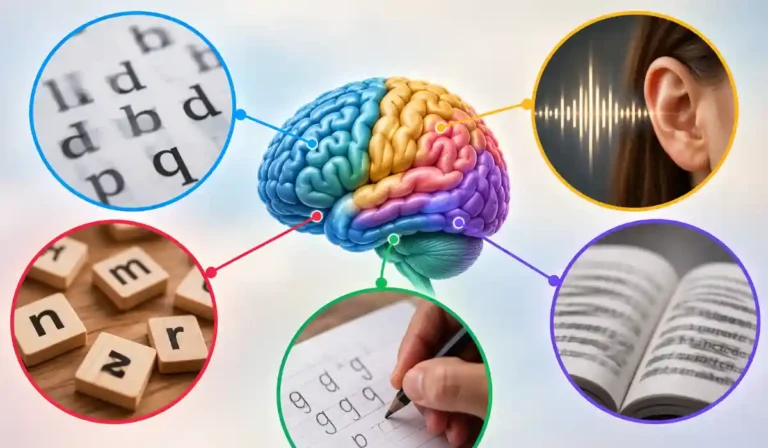
Rather than specific types, clinicians often categorize auditory processing difficulties by subtypes, each linked to different brain regions and producing different patterns of hearing difficulty.
Decoding Deficit
This is the most common type of central auditory processing disorder, where a person struggles to process and distinguish speech sounds, especially when there is background noise or if the speech is too fast. One may swap similar-sounding letters or struggle with phonics, resulting in weak reading accuracy and poor spelling. The condition is tied to the left auditory cortex.
Integration Deficit
Integration deficit is considered one of the most severe forms of auditory processing disorder. It causes a person to have difficulty combining information from multiple senses at once, meaning they might hear the words clearly and understand them in isolation but struggle to connect what they hear with what they see, read, or write.
Associative Deficit
An auditory associative deficit involves trouble applying meaning to sounds that have been heard and decoded correctly. The person hears and processes the sound, but their brain struggles to link it to vocabulary, syntax, or broader meaning. Associative deficit often overlaps with language disorders.
Organization Deficit:
This causes difficulty planning, sequencing, and organizing a response to auditory information. A person with this subtype may understand what they hear but take a long time to respond, can lose track of multi-step instructions, or give jumbled answers.
Auditory Processing Disorder Diagnosis
When diagnosing auditory processing disorder (APD), an audiologist, speech-language pathologist, or mental health professional may ask you questions about symptoms and how long you’ve had them before conducting a few tests, beginning with hearing tests such as:
Tympanometry
This is to check how well your eardrum and middle ear work. For this auditory processing disorder test, a clinician places a soft probe in the ear canal and sends air pressure to measure how the eardrum is moving in response to the air.
Acoustic Reflex Test
This test checks how the ear reacts when you hear a loud sound. A tiny muscle in the middle ear is supposed to automatically tighten, stiffening the eardrum and ear bones to reduce the amount of sound reaching the inner ear.
Evoked Potential Tests
This test measures the electrical signals your brain and spinal cord send in response to a sound, light, or electrical pulse. It shows how sound travels from the ear to the brainstem and along the auditory pathways, helping detect issues that may not appear on a routine neurological exam.
If these tests show that you have no hearing loss, then the clinician moves to the following set of auditory processing tests to diagnose potential auditory processing disorder:
Speech-in-Noise
This auditory processing disorder test measures how well you can understand spoken words or sentences when there is background noise. It reflects real-world listening situations and checks how much noise you can handle.
Dichotic Listening
This test checks how well your brain can separate, attend to, and integrate multiple auditory inputs. Usually, the clinician plays words, digits, or syllables at the same time, one into each ear, and you are asked to repeat what was heard.
Temporal Processing
This test checks your brain’s ability to perceive and use the timing of sounds, such as when a sound starts and stops, how long it lasts, how quickly it changes, and their order. You hear simple sounds like beeps or tones, and are then asked how many sounds were heard and their pattern.
Auditory Processing Disorder Treatment
Auditory processing disorder treatment is based on the patient’s specific needs and may include:
- Hearing Aids and Listening Devices: Your audiologist may recommend using hearing aids with listening devices that help direct sound to your ear.
- Frequency Modulated (FM) and Digital Modulation (DM) Systems: These devices send sounds to your ear so you can hear them better. They work alongside a hearing aid and direct sounds to it. Frequency Modulated (FM) and Digital Modulation (DM) help make it easier to hear sounds in noisy environments.
- Auditory Training: Auditory training helps people with auditory processing disorder to better process and understand sounds. An audiologist, a speech-language pathologist, or both may train you one-on-one or as part of a group, learning to differentiate between various sounds.
- Computer-Based Training: Computer-based training involves a software program installed on your computer to help train the brain to pick out and understand sounds. It works similarly to auditory training and can be done at home.
Conclusion
Auditory processing disorder (APD) is a lifelong neurological condition that impairs how your brain processes and interprets sound, even when your hearing is intact. APD diagnosis is carried out in two steps: first, to rule out hearing loss through tympanometry and acoustic reflex tests, followed by specialized assessments such as dichotic listening, speech-in-noise, and temporal processing to identify the specific auditory processing disorder subtype.
Once diagnosed, the condition can be effectively managed through tailored strategies that combine assistive technology such as frequency modulated (FM) and digital modulation (DM) systems with auditory rehabilitation to strengthen brain-to-ear neural pathways and improve sound recognition and discrimination.
If you or a loved one struggles to understand speech in a noisy environment, follows multi-step directions, or takes noticeable time to respond to questions, maybe it’s time to schedule an audiologist’s appointment and check for potential auditory processing disorder.
FAQs
1. How can I tell if I have auditory processing disorder?
You may have auditory processing disorder (APD) if you hear sounds normally but struggle to understand speech, especially in noisy places, from fast talkers, or when following multi-step spoken instructions. People with APD often ask to repeat questions and misuse similar-sounding words in sentences.
2. What are some tips for people with auditory processing disorder?
APD is a lifelong neurological condition in which a person with normal hearing might struggle to process and interpret sounds. Practical tips to counter the situation include facing the speaker when listening or speaking, reducing background noise, breaking down instructions, pausing before responding, and writing down important details.
3. Can auditory processing disorder go away?
APD is a lifelong neurological condition that is not curable. However, it can be effectively managed over time with hearing therapy and assistive technologies such as FM or DM systems and hearing aids.
4. What is an auditory processing disorder test?
An auditory processing disorder test is a specialized evaluation conducted by an audiologist or speech-language pathologist to measure how well your brain is able to process and understand sounds and speech, especially in a noisy environment. It is different from a standard hearing test.
5. Who should get an auditory processing disorder test?
You should get an auditory processing disorder test if you can hear normally but often struggle to understand speech in noisy places, follow spoken directions, or struggle to keep pace with fast talkers. An audiologist first conducts a standard hearing test to rule out hearing loss.