Classroom Strategies For Students With Dyscalculia: A Practical Guide For Teachers
Students with dyscalculia can struggle to make sense of numbers, hold basic maths facts in memory, spot patterns, or work through a problem from start to finish. Good classroom strategies for students with dyscalculia make lessons easier to access, take some of the fear out of maths, and give learners room to build confidence. None of this means watering down the curriculum. Teachers can keep the maths intact and change how it is taught by adapting instruction, putting the right tools on the desk, and allowing enough time for new skills to settle through practice.
Dyscalculia is a specific learning difficulty that affects how people learn maths, and it shows up differently from one student to the next. One child might have a shaky sense of what numbers represent. Another copes with quantity but struggles with calculations, sequencing, telling the time, or handling money. An inclusive classroom starts with noticing which of these is going on, because support only works when it targets the right barrier.
Understanding Dyscalculia In The Classroom
Dyscalculia can interfere with how students grasp quantity, link a numeral to the amount it stands for, remember procedures, and use calculations in daily life. A common pattern is the student who follows a demonstration perfectly, nods along, then cannot manage a near-identical question alone ten minutes later. Others need a concept explained several times, in several ways, before a number pattern or the order of steps in a calculation finally sticks.
None of this should be read as laziness, low effort, or a lack of intelligence. Teachers do better by watching closely, pinning down the specific barrier, and talking to parents and learning-support staff when the picture needs more input. Early intervention matters most, because support that strengthens basic numeracy skills, such as counting, comparing quantities and place value, pays off long before fractions and multi-step problems arrive.
Effective Classroom Strategies
The strongest dyscalculia teaching methods mix explicit instruction, practical work, visual resources and frequent feedback. Which blend works depends on the student: what they need, what they already understand, and where they are heading next.
1. Use Hands-On Materials and Visual Learning Tools
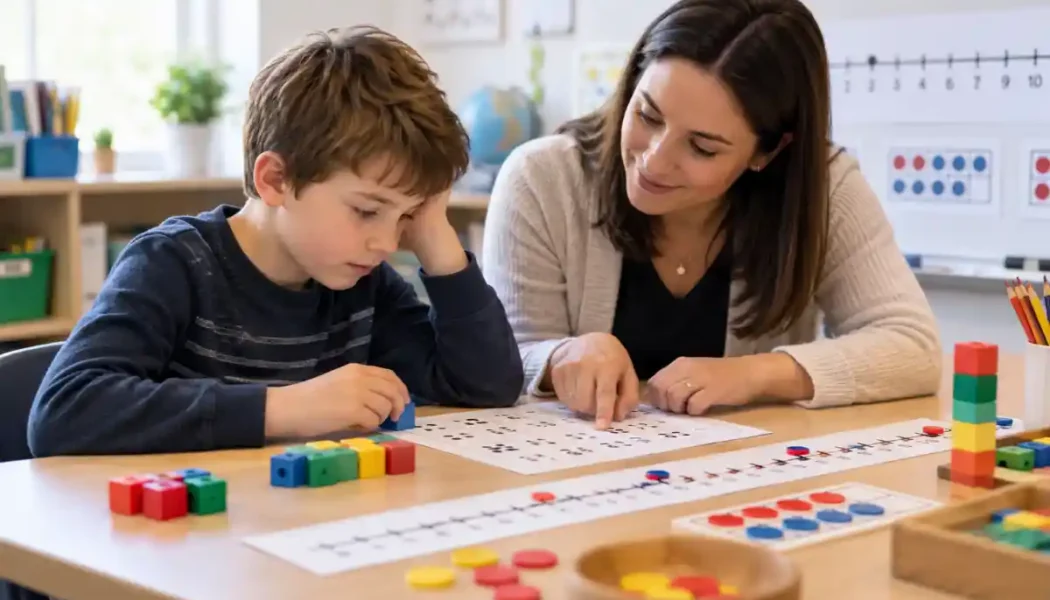
A numeral on a page is an abstraction, and for many dyscalculic learners it stays meaningless until they can see and handle what it stands for. Counters, building blocks, beads, number lines, fraction strips and base-ten blocks all make relationships between numbers visible. A student learning addition might push two groups of counters together, draw them, and only then write 4 + 3 = 7. That order, from objects to pictures to symbols, is known as the concrete-representational-abstract (CRA) sequence. Don’t take the manipulatives away too soon, and let students return to them without treating it as a step backwards. Dice and dominoes help as well, since they train students to recognise small quantities at a glance.
2. Break Mathematical Problems into Smaller Steps
Long calculations and multi-step word problems put heavy demands on working memory and sequencing, which are exactly where many of these students struggle. Model one step at a time, say out loud why each step happens, and give students a written checklist they can use on their own. A word problem can be split into five moves: find the question, pick out the information that matters, choose the operation, calculate, then check the answer makes sense. A laminated card on the desk does this job better than a poster at the front of the room, because students don’t have to look away from their work to use it.
3. Connect Maths to Everyday Situations
Maths tied to something real is easier to understand and far easier to remember. Shopping role-play works for money, the class timetable for time, recipes for fractions, and football or netball scores for adding and subtracting. Ask students where they’d use a skill outside school, and encourage them to explain it with proper mathematical language such as “total”, “difference” and “share equally”. Activities like these show learners that maths has a real purpose, something a stack of worksheets rarely manages.
4. Provide Repeated Practice and Regular Revision
Students with dyscalculia often need more passes at a concept before they can recall it with confidence. Open each lesson with a quick review of earlier material, introduce one new skill at a time, and come back to it through varied activities. Number games, flashcards, short quizzes and guided practice all reinforce learning without piling on pressure. Get accuracy and understanding secure first, and leave speed and harder questions until later.
5. Offer Appropriate Learning Accommodations
The right learning accommodations let students show what they understand without tripping over barriers unrelated to the lesson. Depending on the objective, that could mean extra time, graph paper to keep columns aligned, a multiplication chart, or a calculator when mental arithmetic isn’t being assessed. Clean worksheets with plenty of space and fewer questions per page also cut down distractions. The test for any adjustment is whether it supports the intended outcome. A calculator is fine in a lesson on choosing the right operation, but in a lesson on times tables it removes the very skill being taught.
Creating A Supportive Environment
Teaching methods only go so far if the room doesn’t feel safe. Students who’ve struggled with maths for years often carry frustration, embarrassment, or real dread about getting answers wrong. Good maths anxiety support starts with ordinary habits: welcoming questions, noticing effort, and giving corrective feedback quietly and one to one where possible.
Timed activities shouldn’t be the default way of judging ability, especially when speed isn’t the point of the lesson. Give students proper thinking time and ask them to explain their reasoning in their own words. When praising, be specific. “You spotted that this needs subtraction” tells a student far more than a tick beside the final answer, and it rewards the thinking rather than only the result.
Working with parents, special educational needs staff and learning-support professionals keeps strategies consistent between school and home. If difficulties continue despite good support, the school should consider formal assessment and an individual plan. Reviewing progress regularly shows which adjustments are earning their place and where extra teaching is still needed.
How To Monitor Progress And Adapt Teaching Methods
Test scores alone tell a teacher surprisingly little about a dyscalculic learner, so ongoing observation does the heavy lifting. Brief notes are enough: which skills the student has mastered, which mistakes keep coming back, and which resources make a difference. Short, low-stakes checks reveal whether a student can manage a concept independently or still relies on prompts and practical materials.
Targets should be small and reachable, such as recognising number bonds to 10, understanding place value in three-digit numbers, or finishing a multi-step calculation with a checklist. Review them often and change the approach when progress stalls. Over time, these records help a teacher tell the difference between a concept that needs explaining again and one that simply needs more practice.
Conclusion
Supporting students with dyscalculia takes patience, structured teaching, and a clear picture of each learner’s needs. Practical resources, problems broken into manageable steps, links to everyday life and sensible accommodations all make maths more accessible. The classroom strategies for students with dyscalculia that work best pair clear instruction with regular practice, encouraging feedback and steady progress monitoring. With that kind of consistent support, students can deepen their understanding, grow in confidence, and take a fuller part in lessons.
Frequently Asked Questions
1. What are the most effective teaching methods for dyscalculia?
Explicit instruction, hands-on activities, visual aids, step-by-step explanations and regular revision work best, especially when they’re tailored to what each student needs.
2. Should students with dyscalculia be allowed to use calculators?
Yes, when it suits the lesson. Calculators support problem-solving whenever arithmetic itself isn’t the main learning objective.
3. How can teachers reduce maths anxiety?
Give plenty of thinking time, avoid public comparisons, make questions welcome, and recognise progress so students can build confidence gradually.
4. How can teachers identify dyscalculia in the classroom?
Watch for persistent trouble with number sense, calculations, number patterns and mathematical sequencing, then involve learning-support professionals for a proper assessment.
5. What classroom tools help students with dyscalculia?
Number lines, counters, base-ten blocks, graph paper, multiplication charts and visual schedules all help make mathematical ideas easier to grasp.