
Auditory Processing Disorder Test: How It Works And What To Expect During Diagnosis
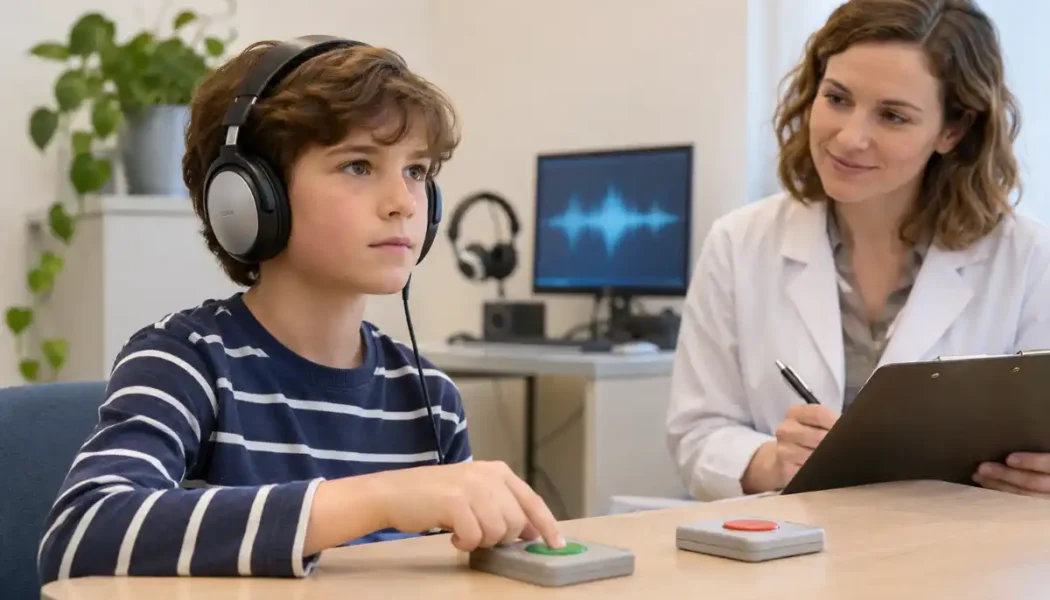
Auditory processing disorder (APD), which is also called central auditory processing disorder (CAPD), is a condition in which the brain cannot process or interpret sound signals. A person with APD can hear sounds and won’t show a hearing loss on a hearing test, but they will have a hard time trying to understand them. To diagnose APD, a healthcare provider will have to conduct tests, including a hearing test, to rule out hearing loss as the cause, and other tests like auditory processing tests, language tests, and psychological tests.
What Is An Auditory Processing Disorder Test?
Auditory processing disorder (APD) is a condition that affects how the brain processes sounds. A hearing test may not show hearing loss, but the person with APD might have trouble making sense of what they hear. It is different from the hearing loss that is caused by an issue in the outer, middle, or inner ear, or by an issue with the auditory nerve. So, to diagnose APD, specialists, including an audiologist, mental health professionals, and speech-language pathologists, will conduct tests. These tests might include:
- Hearing tests
- Auditory processing tests
- Language tests
- Psychological tests
When Should You Consider An APD Test?
An adult or child should get APD testing if they have difficulty understanding spoken information that is not found to be caused by a hearing issue after conducting a hearing test. Consider an APD test if you have concerns like continuous difficulty hearing speech, especially with background noise, group communications, telephone conversations, or spoken directions. Conducting an APD test is not just to label the condition, but to find the auditory strengths and weaknesses of the person through proper evaluation. This helps in providing practical recommendations for school, home, work, and social situations.
Common Signs Of Auditory Processing Disorder In Children And Adults
The signs of APD can seem different in each person. Signs of APD in children include:
- Seems inattentive or easily distracted
- Difficulty understanding speech in noisy environments
- Frequently asks “what?” or “huh?” even when the person has spoken clearly and at a normal volume
- They find reading, spelling, and phonics challenging
- Difficulty locating where the sound is coming from
- Misunderstands or confuses similar-sounding words
- Responses might be slow and inconsistent
- They may have difficulty in following multi-step directions
Common symptoms of APD in adults include:
- Difficulty in following complex or rapid speech, like lectures, podcasts, or fast-talking colleagues]
- Struggles in social gatherings, restaurants, and meetings, especially when there is background noise
- They might need frequent repetitions during phone calls or conversations
- Trouble remembering spoken information like the instructions from a doctor
- Might misinterpret jokes, sarcasm, or tone
- Working in a noisy environment becomes challenging
- Feels mentally exhausted after heavy listening activities
How Does An Auditory Processing Disorder Test Work?
The APD test process involves different assessments that measure how the brain processes sound:
Initial Consultation
The first step in an APD test process is a detailed discussion where the audiologist asks about the symptoms, medical history, and how long the person has had them. In the case of children, parents are supposed to share their observations. Understanding medical history and symptoms can help guide the APD testing.
Hearing Evaluation
Even though APD is not a hearing loss, a hearing test is necessary to conduct, where the audiologist checks for any hearing problems. The person will wear headphones and listen to different sounds to which they will respond. This will confirm their ability to detect sounds at different frequencies, which rules out any problem with hearing. When hearing is found to be normal, then testing moves on to the next step.
Auditory Processing Tests
In this testing, the audiologist assesses how the brain processes sound. It takes place in a sound-treated room where the person will listen to sounds or words and respond to them in different ways.
- Dichotic listening tests: In this test, the person will listen to two words at the same time from two ears. This will test how well both ears work together.
- Auditory closure tests: Background noise can make speech unclear. So, this test mimics real-world conversations in noisy places to test how well the brain fills in the missing sounds.
- Temporal processing tests: Sounds have timing cues, where some words might be short, and some might be long. This test measures how well the brain can recognize, track, and analyse the duration, sequence, and pattern in speech.
Diagnosis And Discussion
After the testing, results are reviewed and explained by the audiologist. They will explain how severe the APD is, what type of APD the person has, and what the treatment methods are.
Types Of Tests Used To Diagnose APD
To diagnose auditory processing disorder, several tests are conducted, starting with a hearing loss screening.
- Tympanometry: This test checks how well the eardrum and middle ear work.
- Acoustic reflex testing: It tests what happens in the ear when the person hears a loud sound.
- Evoked potential tests: These tests check how the brain responds to te sounds.
Once hearing loss is ruled out, the person will then have to go through central auditory tests to check if they have an auditory processing disorder.
- Speech-in-noise test: This test checks how well the person is able to understand speech when there is background noise.
- Dichotic listening: It checks how well the person can process different sounds sent to each ear at the same time.
- Temporal processing: This test checks how well the brain can handle and recognize the timing and pattern in sounds.
Conclusion
There is no fixed criteria for an auditory processing assessment. Each person experiences APD differently, and hence an auditory processing diagnosis can vary from person to person. So, it is important that anyone who experiences auditory processing symptoms consult an audiologist who specialises in auditory processing for a proper assessment. An auditory processing evaluation is not limited to standardised auditory processing tests, but also includes preliminary tests to rule out hearing loss, and other tests to rule out or acknowledge the effects of conditions that share similar symptoms with APD.
Frequently Asked Questions
1. How long does an auditory processing disorder test take?
An auditory processing disorder test typically takes about 2 to 4.5 hours, but this might be split into two or more sessions of about 1 hour each, particularly for children.
2. How are APD test results interpreted?
The audiologists interpret the APD test results based on age-matched expected results known as normative data, or the person’s baseline results. They may also compare the results of different tests to look for patterns.
3. Can auditory processing disorder be diagnosed at any age?
No, auditory processing disorder cannot be diagnosed at any age. There is no upper age limit to be diagnosed, but there is lower age limit in which a child must be at least 7 for an APD diagnosis.
4. What happens after an auditory processing disorder diagnosis?
After the diagnosis, the audiologist, along with the speech-language therapist, creates a management plan for the improvement of APD, which suits the person’s auditory processing deficit profile.
5. How to prepare for an auditory processing disorder test?
To prepare for an auditory processing disorder test, you have to bring your hearing tests, school evaluations, or related records, if any. And ensure you are well-rested the night before, as you will have to perform listening tasks without being tired.