Learning Disability Evaluation in New Jersey: What To Know? Testing And Support

A learning disability evaluation in New Jersey is a structured assessment that determines whether a person has a specific learning disability and, for school-age children, whether that disability qualifies them for special education. For students in public schools, the evaluation is free and is carried out by the district’s Child Study Team under rules set out in Chapter 14 of the New Jersey Administrative Code (N.J.A.C. 6A:14). Families can also pay for a private evaluation, and adults can seek testing through clinicians, colleges, or state vocational services. Which path makes sense depends on who is being evaluated and why.
What The Evaluation Measures
A learning disability is a difficulty with acquiring or using specific academic skills that cannot be explained by intellectual disability, vision or hearing problems, lack of instruction, or limited English proficiency. Federal and state rules list eight areas where it can appear: oral expression, listening comprehension, basic reading skills, reading fluency, reading comprehension, written expression, mathematics calculation, and mathematics problem solving.
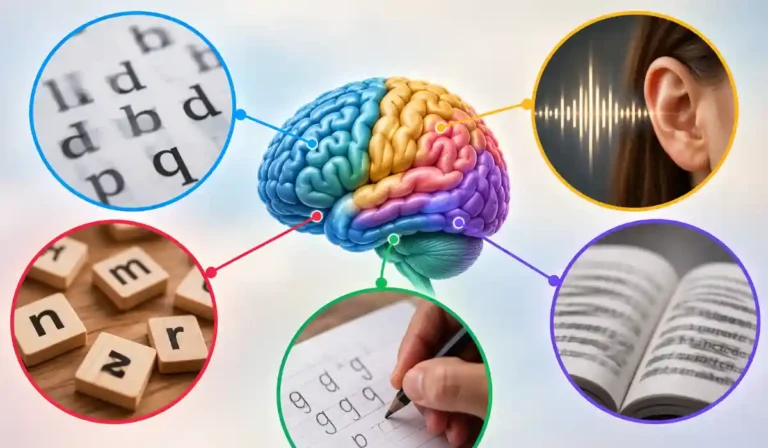
A thorough evaluation looks at several layers at once. Cognitive testing examines reasoning, memory, and processing speed. Academic achievement testing shows how a person actually performs in reading, writing, and math. Many evaluations also include classroom observation, a review of school records, interviews with parents and teachers, and a social history. Dyslexia, dysgraphia, and dyscalculia are the most commonly discussed specific learning disabilities, and a strong evaluation will name the pattern rather than simply report that a child is “behind.”
Public School Students: The Child Study Team Route
Most New Jersey families begin here, and for good reason. The district evaluation costs nothing, and its results feed directly into eligibility for an Individualized Education Program (IEP).
Who conducts it
Each district maintains a Child Study Team, usually made up of a school psychologist, a learning disabilities teacher-consultant (often called an LDT-C), and a school social worker. The psychologist typically handles cognitive testing, the LDT-C handles academic and learning-process testing, and the social worker gathers family and developmental history. Speech-language specialists, occupational therapists, or physicians may be added when a concern falls in their area.
The Timeline
A parent can start the process by submitting a written request for evaluation to the school, usually to the principal or the director of special services. Putting the request in writing matters, because the state clock starts on the date the district receives it. Within 20 calendar days (excluding school holidays, though not summer break), the district must hold an identification meeting with the parent to decide whether an evaluation is warranted and, if so, what it will include.
If the team agrees to evaluate, the parent signs consent. From that signature, the district has 90 calendar days to complete the testing, determine eligibility, and, if the student qualifies, develop and put an IEP in place. New Jersey requires an initial evaluation to include at least two assessments, and the parent is entitled to copies of the evaluation reports at least 10 calendar days before the eligibility meeting.
How eligibility Is decided
Testing alone does not settle eligibility. The team must find that the student has a specific learning disability and that it adversely affects educational performance to the point that special education is needed. New Jersey’s regulations permit districts to identify a learning disability through a severe discrepancy between ability and achievement or through a student’s response to scientifically based interventions, and the method used should be explained in the eligibility report. A student who has a learning disability but does not need specialized instruction may still qualify for accommodations under a Section 504 plan, which covers measures such as extended test time or access to audiobooks.
Young Children And Early Screening
New Jersey does not wait for children to fail before looking for reading problems. A state law passed in 2013 requires public schools to screen students for potential indicators of dyslexia and other reading disabilities no later than the first semester of second grade, or when a student in later grades shows signs of reading difficulty. A screening is not a diagnosis, but a flagged result often leads to targeted reading intervention and, when progress stalls, a referral to the Child Study Team.
Children ages 3 through 5 who show developmental delays can be evaluated through their local school district for preschool special education. For infants and toddlers under 3, the New Jersey Early Intervention System handles evaluation and services, and families transition to the district process as the child approaches age 3.
When Families Choose A Private Evaluation
Some parents want a second opinion, a faster appointment, or a more detailed diagnostic picture than a school evaluation provides. Private evaluations are usually performed by licensed psychologists or neuropsychologists, and they tend to produce a formal diagnosis, such as dyslexia, along with recommendations for both school and home.
Private testing has real strengths. Clinicians often spend more hours with the child, explore attention and emotional factors in depth, and can test children who attend private school or are homeschooled. The main drawback is cost, which varies widely by provider and region, and health insurance does not always cover educational testing. Families considering this route should ask in advance what the fee includes, whether a feedback session is part of the package, and whether the report will be written in a way the school can use.
A district must consider a private evaluation when making decisions about a student, but it is not required to adopt its conclusions. That distinction surprises many parents.
Disagreeing With The School’s Results
Parents who disagree with a district evaluation have a specific right that is easy to overlook: they can request an independent educational evaluation (IEE) at public expense. The independent evaluator is someone not employed by the district. Once a parent makes the request, the district has 20 calendar days to either agree to fund the IEE or file for a due process hearing to defend its own evaluation.
This right applies to evaluations the district has already completed, so the sequence matters. A parent generally needs the district’s testing on record before asking for an independent one. Families who feel stuck can contact the Statewide Parent Advocacy Network (SPAN), a New Jersey nonprofit that helps parents understand special education procedures, or consult the state’s Parental Rights in Special Education booklet, which districts must provide.
Adults Seeking an Evaluation
Learning disabilities do not disappear at 18, and many adults are identified for the first time in college, in a training program, or after years of struggling quietly at work. Adults in New Jersey usually pursue evaluation through a private psychologist or neuropsychologist, a university clinic that offers testing at reduced cost, or a college’s disability resource office.
The New Jersey Division of Vocational Rehabilitation Services is another option for adults whose disability affects their ability to find or keep a job. The agency can arrange assessments as part of determining eligibility for employment services. An adult diagnosis can also support requests for workplace accommodations under the Americans with Disabilities Act and the New Jersey Law Against Discrimination.
A Quick Comparison of the Main Routes
| Situation | Usual starting point | Cost to family | Key timeline |
|---|---|---|---|
| Public school student, K–12 | Written request to the school | Free | 20 days to identification meeting; 90 days from consent to IEP |
| Child ages 3 to 5 | Local school district | Free | Same district timelines apply |
| Child under 3 | NJ Early Intervention System | Free or sliding scale | Set by Early Intervention |
| Disagreement with school results | Request for an IEE | Free if granted | District responds within 20 days |
| Private or homeschooled student | District or private clinician | Free through district; private fees vary | Varies |
| Adult | Private clinician, college, or DVRS | Varies | Varies |
Preparing
A few records make any evaluation more accurate. Report cards, standardized test scores, samples of written work, results from the second-grade dyslexia screening, and notes from teachers all help evaluators see patterns over time. Medical records belong in the file as well, especially vision and hearing results, since evaluators must rule those out.
Keeping copies of every request, consent form, and report also protects a family’s position, since New Jersey’s timelines run from documented dates. A learning disability evaluation is ultimately a tool for matching instruction to the way a person learns, and the clearer the record going in, the more useful the results coming out.
Read More:
- Learning Disability vs Learning Difficulty: Dyslexia, Dyscalculia, Identification And Support
- Self-Advocacy Skills For Adults With Learning Disabilities: A Practical Guide
- How To Prepare For Your First IEP Meeting: A Complete Guide For Parents
- Classroom Strategies For Students With Dyscalculia: A Practical Guide For Teachers